



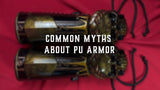


If you've spent time in the LARP community, you've probably heard plenty of opinions about polyurethane armor. Some are based on real experience, while others come from products made many years ago or from assumptions about the word "plastic." Over time, manufacturing methods, materials, and painting techniques have improved significantly, but many of the same misconceptions continue to circulate.
In this article, we'll look at some of the most common myths and explain where they come from.
Myth #1: Polyurethane Armor Looks Fake
This is probably the most common criticism, especially from people who have only seen inexpensive costume armor or mass-produced Halloween props.
In reality, the material itself has surprisingly little influence on how realistic the finished piece looks. What people actually notice is the quality of the sculpt, the sharpness of the mold, the painting techniques, weathering, surface textures, and overall design.
A well-made composite armor piece can reproduce extremely fine details, from engraved ornaments and hammered metal textures to worn edges and battle damage. These details are created long before the casting stage and are preserved by high-quality silicone molds throughout production.
Painting plays an equally important role. Layered acrylic colors, oil washes, metallic effects, and weathering techniques borrowed from scale modeling all contribute far more to the final appearance than the choice of casting material itself.
For most observers, it's almost impossible to identify the material simply by looking at photographs or seeing the equipment from a few meters away during an event.
Myth #2: Plastic Armor Breaks Easily
This misconception usually comes from comparing modern composite equipment with inexpensive vacuum-formed plastic costumes or thin thermoplastic props.
The reality is quite different.
Most professionally manufactured composite armor is reinforced internally with fiberglass, creating a structure that is significantly stronger than solid polyurethane resin alone. The fiberglass carries much of the mechanical load while the resin holds the structure together and preserves surface detail.
Like any commonly used material, composite armor has its limits. It is not indestructible, and no responsible manufacturer should claim otherwise. However, when properly designed and reinforced, it is perfectly capable of withstanding the repeated movement, impacts, and handling typical of LARP events. We still do not recommend rolling on the ground in your PU armor kit.
Durability depends far more on engineering, reinforcement, wall thickness, and manufacturing quality than on whether the material is described as "plastic."
Myth #3: Steel Is Always Better
This is perhaps the oldest debate in the LARP community.
Steel, and sometimes titanium, remains the best choice for people seeking maximum historical authenticity, traditional craftsmanship, or participation in activities that require real metal equipment. For historical reenactment, steel often remains the only viable option, reinforced by strict gatekeeping for those niche events.
LARP, however, is not always about historical accuracy alone. Modern events frequently involve several days of roleplay, long walks between camps, fantasy settings, photography, performances, and continuous wear for many hours.
In these situations, different priorities begin to matter. Lower weight, greater mobility, reduced fatigue, easier transport, and simplified maintenance are all important factors when choosing equipment.
Rather than asking which material is "better," a more useful question is:
Which material is better suited for the type of event you plan to attend?
Different options solve different problems, and understanding those differences helps players choose equipment that matches their own goals rather than someone else's expectations.
Myth #4: Lightweight Armor Doesn't Feel Real
Many first-time users expect lighter equipment to feel less authentic simply because they associate weight with quality. But in practice, based on our experience, immersion comes from much more than kilograms and pounds. A well-designed character, convincing paintwork, realistic proportions, appropriate clothing, and confident roleplay all contribute to a character's believability. Sometimes unrealistic proportions may even be intentional, especially if you are playing a towering troll or another exaggerated fantasy creature.
After wearing equipment throughout an entire weekend, many players discover that comfort often has a greater impact on their overall experience than the weight of the armor itself.
Myth #5: Composite Armor Is Only for Beginners
This assumption occasionally appears because lightweight equipment is often recommended to new players.
In reality, experienced LARPers, professional performers, event organizers, photographers, NPC teams, and content creators also choose composite equipment for practical reasons. Spending an entire weekend in armor places very different demands on equipment than wearing it for a short photoshoot.
As LARP events become larger and more physically demanding, experienced players often prioritize comfort and mobility alongside appearance. At some point, you can take a look at stunt performers from almost any fantasy movie and ask yourself whether lightweight costume techniques are really only for beginners.
Conclusion
Many of the common myths surrounding polyurethane LARP armor originated years ago, when manufacturing methods, materials, and finishing techniques were far less advanced than they are today. While no material is perfect for every situation, modern composite equipment has evolved into a practical option for a wide range of applications.
The most important lesson is not that one material is universally superior to another, but that every material involves its own compromises. Understanding those trade-offs allows LARP players to choose equipment that best matches their style of play, character, and the types of events they enjoy.