





As long as we hear knights, we imagine a medieval warrior in armor who fights fiercely on the battlefield. However, not all medieval fighters are the same. Templars, Hospitallers, Teutonics, and crusaders are among the most popular types of “armored warriors” chosen as characters for LARP events. Among them, crusader knights are misunderstood the most.
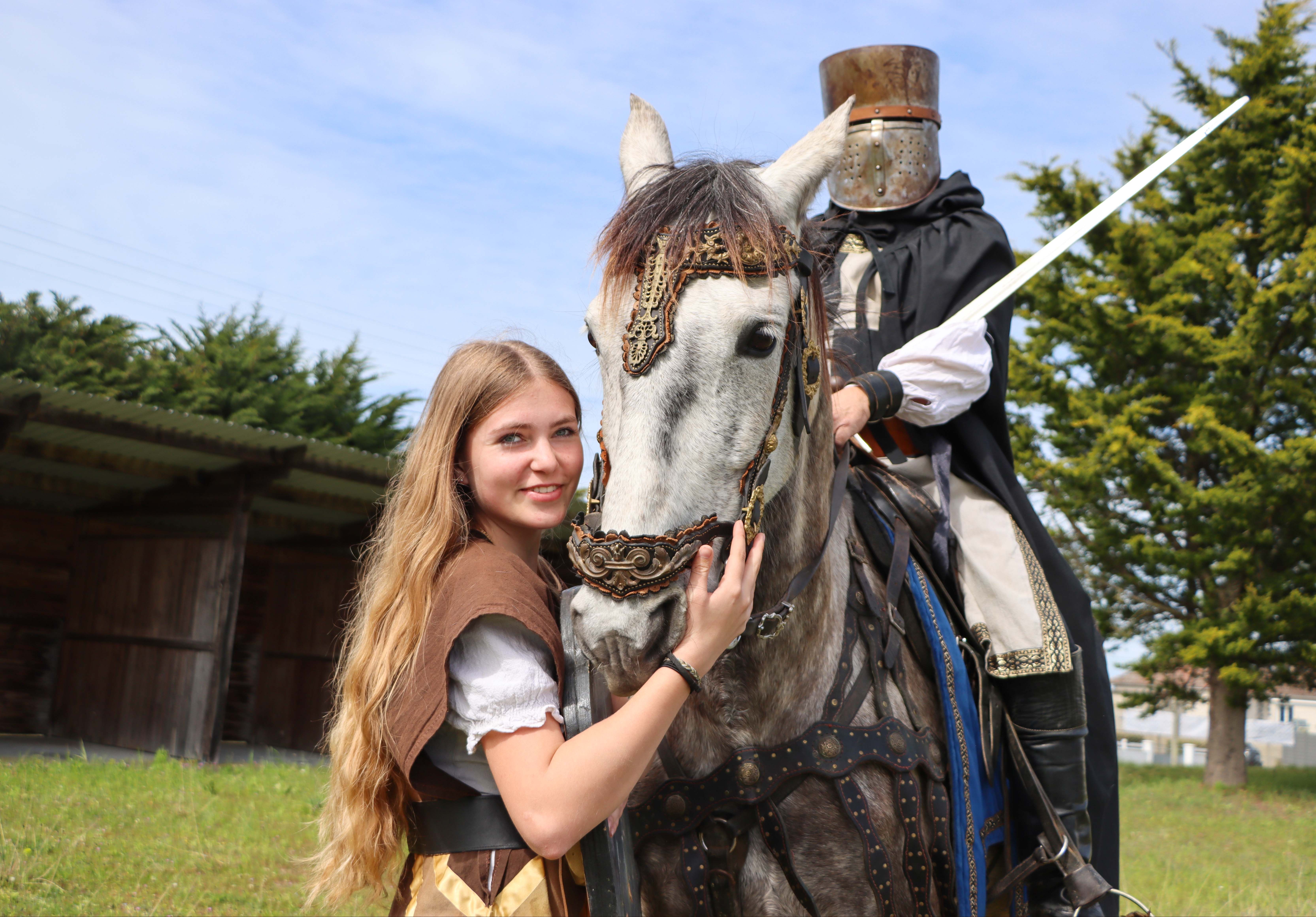
Thus, to ensure that you are well aware of what crusaders are when you decide to be one in your next role-play event, we have prepared a comprehensive guide. It answers the question of what they are, what they wear, and how they behave. This way, you can shop full knight armor sets and be sure to represent them accurately and with true historical immersion.
Who Were the Crusader Knights?
Crusader knights were medieval soldiers who fought in the holy wars known as the Crusades. Often, these were nobles or vassals within the feudal system. They were deeply religious and pledged an oath of service to Christendom. So, it is the mix of faith, duty, and the promise of spiritual rewards that motivated them.
They stitched a cross onto their garments. This was a visible sign of their vow to God. This symbol distinguished them from ordinary soldiers. They were pilgrims as well as warriors. Crusader knights embodied ideals of chivalry and the code of honor. They fought to reclaim or defend the Holy Land, namely Jerusalem. However, their campaigns were not limited to the Levant, but also:
- fights for Spain against Muslim rulers;
- battles in the Baltic against pagans;
- conflicts within Europe against heretical groups.
So, to understand who were the crusader knights, it is worth remembering that it was their religion that led them to participate in battles. They were bound by spiritual obligations and often financed their own equipment. Their role was cast as that of a military expedition and a sacred pilgrimage. As such, they became central figures in the Crusades and helped to create the figure of the fighter as defender of faith.
The Origins of the Crusades
The Crusades began in 1095. It is the year when Pope Urban II called for the First Crusade at the Council of Clermont. It happened in response to the Byzantine Empire’s request for aid against Turkish advances in Anatolia. However, a hidden reason also drove it: a broader desire to reclaim Christian holy sites. The papacy urged those in faith to fight for Christ to earn salvation. That is why the Crusades are seen as both a defensive war and a penitential pilgrimage.
The first campaign was remarkably successful. Crusaders captured Jerusalem and established several states in the Holy Land. These victories inspired further events, and there were also the Second, Third, and Fourth Crusades. Successive campaigns were launched to defend or reclaim lost territories. Over time, this movement became a broad institution. It was supported by papal decrees, taxation of clergy, and the rise of military orders.
Life and Code of a Crusader Knight
Medieval times are synonymous with chivalry and codes of conduct. Crusader knights had their own set of rules, strongly connected to faith, oath, and a strict code of honor. Thus, there was always a combination of the rigors of warfare with the discipline of religious devotion.
Chivalry, Faith, and Vows
Crusaders followed the code of chivalry with loyalty, courage, and service to both God and lord. These warriors were nothing like the non-religious ones. They gave vows before embarking on campaigns and promised to:
- defend Christendom;
- protect pilgrims;
- defend the sanctity of the Holy Land.
So their oath was, in fact, not only to their earthly lords but to God as well. Also, these warriors lived under the constant reminder that their actions had eternal consequences. Victory was divine favor, but failure could be seen as punishment. Their faith guided their conduct.
Weapons, Armor, and Heraldry
Despite all the religious callings, crusader knights were very practical warriors. They were prepared for savage warfare. Their weaponry included:
- The arming sword, a straight double-edged sword with a crossguard, approximately 100 cm in length. It was employed for close-quarters cutting and thrusting.
- The lance, a wooden shaft measuring 2.50 to 4 meters long with a sharp iron tip, was the primary weapon for mounted charge.
- Impact & pole weapons (battle axes, maces, morning stars, and quarrel hammers), designed to dent or break through mail and padded layers.
The armor of these knights was barely what we associate with that word now. Gambeson, a thick, quilted undergarment stuffed with wool or linen tow, was at the core. This padded layer absorbed blunt‑force trauma and prevented the iron rings of mail from chafing the skin. Warriors wore a mail hauberk over it. This was a knee‑length shirt composed of tens of thousands of interlocking iron rings.
Head protection has gotten stronger over time. Early knights wore conical helms with nasal guards, but by the mid‑12th and 13th centuries, these developed into fully enclosing great helms or barrel helms.
To shield themselves from the sun, crusaders adopted the surcoat. This loose, sleeveless garment was worn over mail. It protected the armor from heat and displayed heraldic symbols. Crosses and family crests marked allegiance, while colors distinguished different orders:
- the Templars bore red crosses on white;
- the Hospitallers white on black;
- the Teutonic Knights black on white
This was important, as there were several orders by the mid-12th century. It was difficult to identify warriors on the battlefield because of the closed-face helmets, and heraldry helped a lot with that.
Crusader Knights vs Other Medieval Knights
The image of the crusader knight is often conflated with that of other medieval knights, yet their roles, motivations, and identities were distinct. They all followed the code of chivalry and fought. However, crusaders were much different from other medieval warriors.
They participated only in papal‑sanctioned campaigns to reclaim or defend the Holy Land. They were not merely feudal retainers but warriors who took an oath to “take the cross”. This transformed them into both soldiers and pilgrims, so they always combined martial duty with spiritual devotion.
Their motivation was deeply tied to faith, salvation, and the promise of indulgences. As a result, their battles often seem like more than just military expeditions. They are considered sacred pilgrimages.
Religious Knights
Crusaders are not the only religious warriors of that time. There were religious knights who served within Europe but did not necessarily join the Crusades. These fighters often lived in local monasteries, bishoprics, or cathedral chapters. Thus, they often blended spiritual service with martial duty. However, they did not go anywhere. Their main goal was to defend church lands. So, they believed more in protection rather than expansion.
Feudal Knights
They were the core of the warriors in medieval Europe and served their lords or kings. Their loyalty was rooted in:
- land grants;
- protection;
- noble lineage.
They defended castles and enforced the law. They often fought in dynastic wars and were rarely far from home. Their battles were political rather than spiritual. Still, they shared the virtues and code of honor.
Tournament Knights
These fighters were all busy with jousts, melees, and ceremonial combat. Their role was often associated with prestige, skill, and public spectacle. Tournaments allowed them to demonstrate martial prowess and win favor. They often stood out with elaborate heraldry, which was designed to impress audiences.
Mercenary Knights
Mercenary knights represented a more pragmatic side of medieval warfare. These knights offered their services for pay, fighting in conflicts across Europe without feudal or religious ties. Their motivation was wealth rather than faith or oath. Their reputation was mixed. Mercenaries were valued for skill. Still, sometimes, they were viewed as dishonorable compared to crusaders or feudal retainers.
Legacy of the Crusader Knights
The legacy left by these fighters is immense. It gives us a mix of chivalry, faith, and medieval warfare. They were the archetypal pious medieval warrior, sworn to loyalty to the papal summons, and they left the monastic military orders, disciplined brotherhoods that continued to affect European politics and economics long after the Crusades were over.
The image of the crusader knight, armored, devout, and guided by a code of honor, is thus still a potent symbol in literature, gaming, and LARP culture, representing both the glory and the contradictions of medieval Christendom. They are the warriors who fight for salvation, but also for land, wealth, and power.
Conclusion
It’s important to remember that they were more than just warriors. The Crusaders embodied the ideals of the Middle Ages. Inspired by faith, oath, and the code of chivalry, they fought for salvation. Their campaigns left behind castles, legends, and lasting images of discipline and devotion, which still fascinate us today.
Crusader knights are remembered today as icons of the medieval world that continue to fascinate. They live on in fantasy, gaming, and LARP communities. For roleplayers, these warriors offer the opportunity to embody discipline, heraldry, and devotion, combining historical authenticity with immersive storytelling. If you plan to be a knight at your next role-playing event, would you like to be a Templar, Hospitaller, or a general crusader for your next role-play?